essay
How I built Promptly
nov 2025 · 6 min · arshan kaudinya
The idea for Promptly came right at the end of my summer internship. I was spending way too much time refining prompts, copying them around, and pasting them back into different AI tools. It worked, but it felt painfully inefficient. I wanted a way to refine prompts with my own customizations and use them instantly without juggling tabs. That became the core problem: make the entire prompt workflow faster, cleaner, and customizable.
I started with the smallest possible step — a button that sends my raw prompt to my backend. The challenge was that every AI website has its own DOM structure. I had to reliably parse the HTML for each platform, identify the correct textbox, and wire it to the extension via an API call. Privacy and data-flow discipline mattered — the extension was built so the content never touched any server except the refinement API.
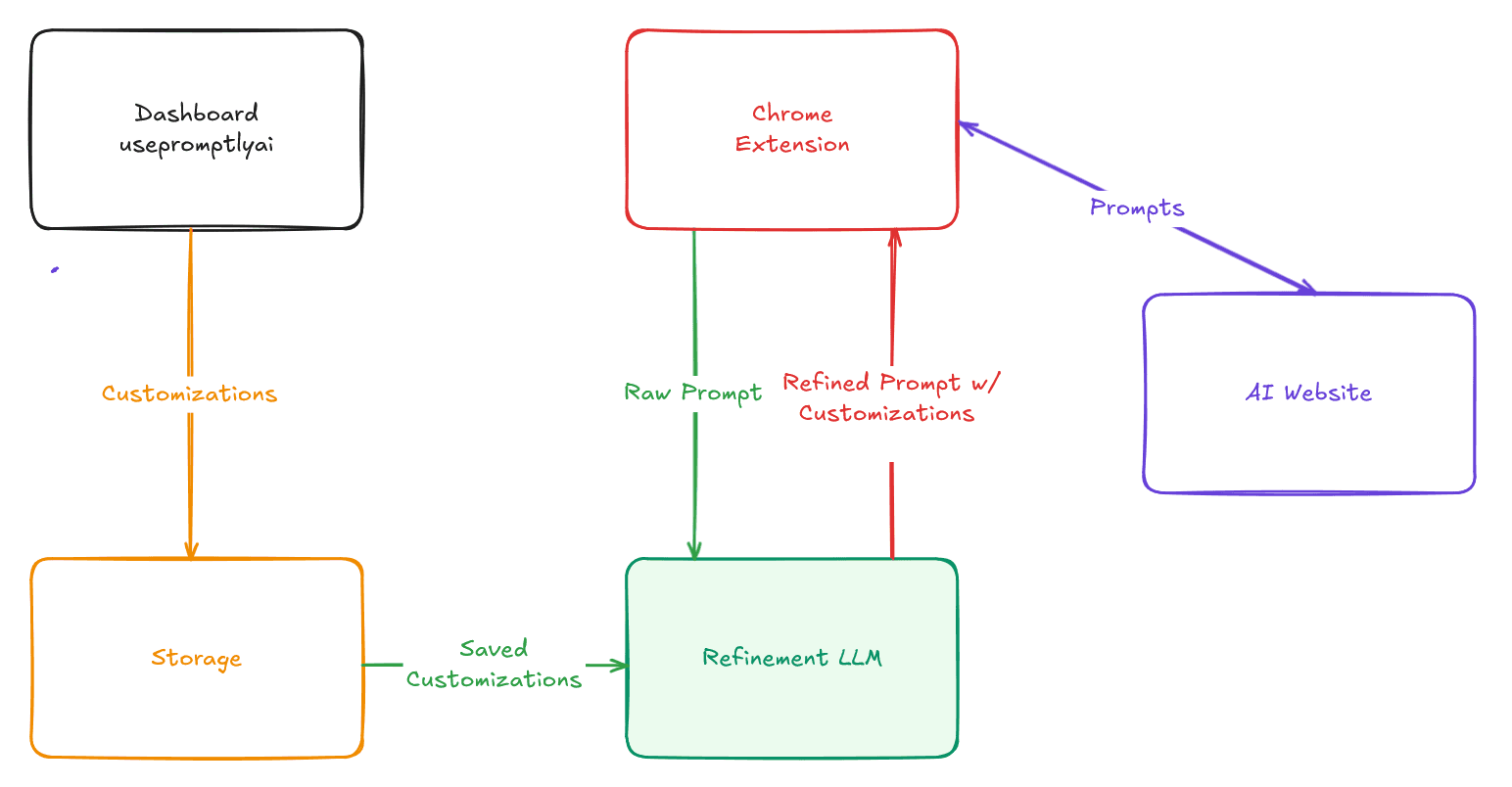
The next step was the real heart of the product: refinement logic and user customizations. I spent days experimenting with what actually improves a prompt, then designed constraints and rule sets for my Refinement LLM. The idea was to teach the AI to cook the prompts and give it the user’s ingredients. Each request carried the user’s settings, and the API returned a refined prompt that the extension wrote back with a smooth animation.
With the core engine working, I bought the domain and built the website. The toughest part wasn’t the tech — it was the design. I wanted a minimal interface that communicated the idea clearly. I spent hours on typography, spacing, and layout until the homepage felt right to me. I moved everything into a clean monorepo, with frontend, server, and extension living in one codebase.
The next week was full-stack work: authentication, user flows, customizations, payments, CRUD, onboarding, and usage limits. All the real SaaS plumbing. By the third week, the MVP was deployed on Vercel and Render.
Real users then shaped the product. They broke things, suggested things, hated things, and pushed Promptly to grow. I added refinement tiers, preset customizations, free plans, tiered instruction depth, custom user instructions, and smoother extension behavior.
Eventually I outgrew Render, and migrated everything to a DigitalOcean droplet with Docker, Nginx, and cleaner routing. It turned into real infrastructure instead of just a “deploy and pray” setup.
Promptly started as a personal solution at the end of an internship. It’s now a real product with users, customization layers, a Chrome extension, a dashboard, and a proper backend. All from one frustration: refining prompts shouldn’t feel like manual labour. I just built the tool I wished I had.
Try it out: www.usepromptlyai.com
← back to writing